Captain’s log #3: Harshmode, stardate 26-08-20
Holding position, awaiting new coordinates
Quote (or passage)
A writer—and, I believe, generally all persons—must think that whatever happens to him or her is a resource. All things have been given to us for a purpose, and an artist must feel this more intensely. All that happens to us, including our humiliations, our misfortunes, our embarrassments, all is given to us as raw material, as clay, so that we may shape our art.
-Jorge Luis Borges, Argentinian author
The best writer is one who can make you feel the story. Creativity is crucial to building the story, but life experiences and observations give it the emotional depth for the author to move the reader. I struggle with emotional depth because I don’t have many life experiences to tap into. I’m trying to focus on my observations, which can be a great resource in itself.
What I’m listening to
In My Life, The Beatles
The rock and roll era began with the Beatles in the 1950s. Few bands inspire me as much as the Beatles, the original. It’s arguable which Beatles song is the best, but it matters not. Today, I’m going with ‘In My Life’. It’s a meaningful song because who we are is a product of our life experiences. We can mature, move on in life, and change our personality. But our past will always remain with us. Don’t forget the people you grew up with, the streets of your hometown, and your experiences growing up. It’s truly a wonderful, relatable, and nostalgic song about the human experience.
Aane Wala Pal, Kishore Kumar
The philosophy in this timeless song by Kishore Kumar complements ‘In My Life’ so well. Life’s moments are transient. Once they pass, they’ll never come again. While you should never forget the past, you must live in the present. If you don’t experience them fully (or attempt to), they will pass by. The present is all we have. The sentiment is bittersweet, but it’s beautiful how the poetry unfolds and depicts our experience of time. This song stays with you as you realize life is more about the journey than the destination.
What I’m writing
I planned to finish chapter 22 this week, but I have had no time to get to ch22 with wedding festivities for my sister. Last week, I discussed different editing types necessary before a novel is ready (developmental editing, line-editing, copyediting, and proofreading). This week, I’ll talk about my developmental editing process.
-The first step after finishing the novel is a reverse outline. My first chapter’s reverse outline: https://docs.google.com/document/d/1TZ8_2UrhYB0GRRyK3QdrB4vFFMt11Tzjcgd5RrF8elA/edit?tab=t.0 . I skimmed through every chapter, noting the important events. I note the ‘who, what, where, when, and why’ of each chapter and the main conflict. Certain details inside who/where/why will repeat. You want to do this for every chapter to keep track of the story and catch plot holes. It’ll be useful throughout the developmental editing process to avoid re-reading the story repeatedly. This probably takes approximately one hour per chapter (some chapters more). While skimming, you want to create brief notes of any issues as you notice.
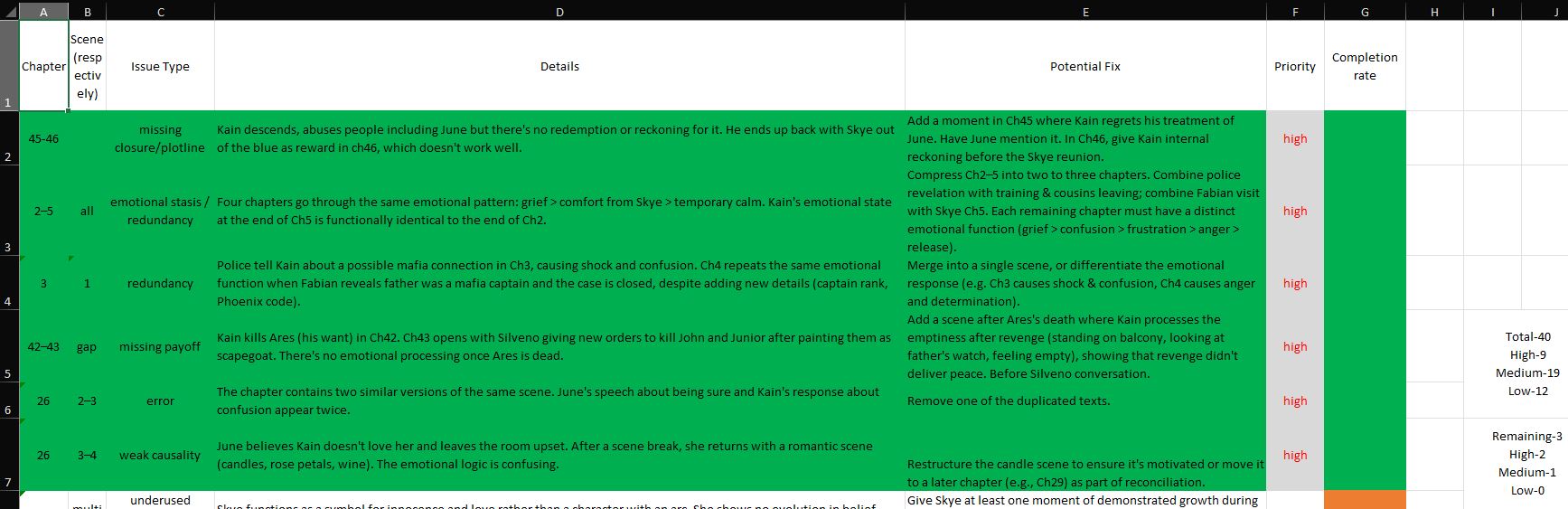
-After reverse outlining, list any spots where the story doesn’t flow well or leaves a hole in an Excel sheet. This part was tough, and I struggled through it. I don’t know how many hours this took, but the reverse outline (and notes taken while doing it) helped the process. I call this the fix list – image below. I estimate this took about 50 hours, and I found about 40 issues.
-Implement things on the fix list. I found 40 issues and fixed 30 of them. Ten more issues remain that I’m unsure how to fix, or the problem might not be a problem, or I held off on implementing it. This took another 40 hours.
Although I estimated developmental editing took over 100 hours, I didn’t time myself over the almost three months. I would say this took me approximately 140 hours to do. Keep in mind this is my first time editing a full-length novel, so I’m figuring it out as I go. I likely missed many plot issues. It’s a learning experience, and I’m not a professional editor.
What I’m playing
I have been playing ‘The Elder Scrolls V: Skyrim’ from 2011. This game has been on my to-play list since then, and I’ve finally gotten to it. I have 90 mods installed that provide quality of life fixes, graphics upgrades, tweaks, animation improvements, audio, and accessibility features. I’m only about ten hours in and have perhaps another 150 hours of play remaining. While I don’t have time to play lately, I’m hoping to get to it once I finish line-editing. I attached a trailer if anyone is unfamiliar with this legendary game, but note that the community-made mods in the 15 years since release allow much better graphics.
What I watched
For Film Night Saturday, I streamed “The Fifth Element” (1997) for my writing group two Saturdays ago. I watched it about twenty years ago, and it’s become a sci-fi classic. It’s truly an entertaining film with action scenes that leave you on the edge. The visuals, special effects, direction, performances, and the music are sensational (Chris Tucker is funny but cringeworthy). If you haven’t seen it yet, go check it out!
I watched ‘Gone With The Wind‘ across two sessions (almost 4 hours long). I want to review it at some point when I get to it. Perhaps in the next couple of weeks. The vibrant colors, the contrast, and the details blew me away. Technicolor was quite something! For 1939 (filmed in ‘38), I’m stunned at the technology. The colors may be better than anything I’ve ever seen. I can only imagine how it looked in the theater upon released. Technicals are almost perfect. Direction, acting, dialogue, visuals, music, cinematography, production value, casting, pacing (for a movie this long!), costume design, makeup, storytelling style, and editing are some of the best I have ever seen in a film. You feel as if you landed in 1865. There are certainly some issues that folks will notice, including slavery, sexism, lack of consent, treatment of children, and lost cause myth that glorifies the Confederate’s side during the US Civil War. Keep in mind this movie was made in 1938 in a different American culture, and we must be careful judging something based on today’s standards and culture. As an anthropology minor, I learned about the dangers of ethnocentrism for both cultures and eras. The movie is great if you can look beyond the issues and judge it as a fictional art rather than a propaganda documentary that must be censored (I don’t believe in censorship except for very specific cases).
I have also been watching the show ‘Halo‘ that is based on the legendary videogame series. The show changed most of the story, but I think it’s well-done. The visuals, fighting scenes, and overall performances are solid. Perhaps the writing could be improved and pacing. It goes through the typical ups and downs, but I think it’s worth a watch for Halo fans.
Looking Ahead
I want to finish editing ch22, ch23, and most of ch24 by the next update. This past week was too busy to get much editing done. I checked forward and noted that these three chapters are shorter, which should help.
That’s it for this biweekly update. Feel free to post questions concerning anything posted here, or if you want me to focus on something specific next time. Carpe diem!