My book club chose Atonement for our October reading. Atonement is a historical literary fiction novel that takes place in 1935, 1940, and 1999. I had my initial hesitations, and the first few pages’ prose led me to believe I wouldn’t finish it. My primary concern was with readability from the writing style’s complex structure. I gave it a chance, and what an experience! Ian McEwan is one of the best modern-day British authors, and he captivated me with this story. He writes in a prose-heavy style that is mostly seen in 19th-century literature.
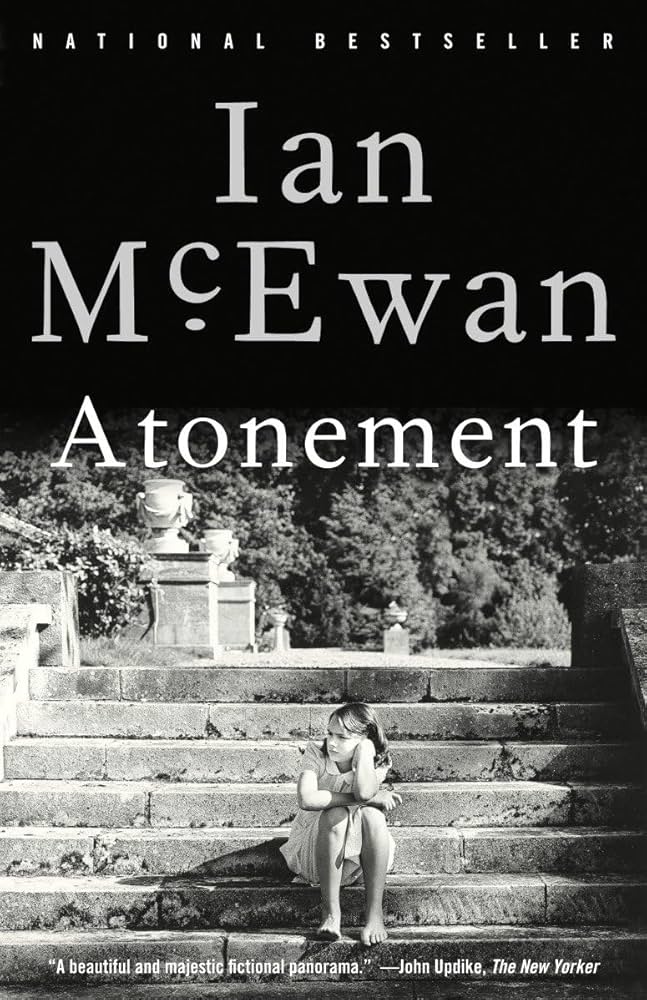
The prose’s depth and richness drew me into the confines of the insight it offered. I rarely read books containing prose as thick to parse through, but this was worth every minute and effort. McEwan places us into the minds of the POV characters, and we see a thorough breakdown of their observations, thoughts, and past anecdotes.
Study and research, I suspect, helped develop the intricate setting and era. Throughout the journey, we travel through pre-WWII Britain, Britain during the war, some areas of the French countryside in the lead-up to the largest military evacuation in history, and 1990s Britain. I do not know how McEwan wrote the hospital scenes of soldiers returning from Dunkirk as the Nazis pushed hard to take over France. I thought back to those times 85 years ago and grieved for those soldiers. The writing detail left me speechless, as if McEwan had stood there jotting notes.
Characters
The main characters are the central key to this mesmerizing tale.
Briony Tallis is a thirteen-year-old girl immersed in curiosity and wonder. It’s a splendid marriage of imagination and creativity, but one that dips into immaturity and naivety. I thought of Scout from Harper Lee’s “To Kill a Mockingbird” and even somewhat of Holden Caulfield from J.D. Salinger’s “The Catcher in the Rye.” These characters must navigate through the mud of reality that they don’t grasp. Everyone does on their coming-of-age path. Much like Scout, she experiments with her ideas and attempts to interrogate life. She had reached the adolescence stage, where one begins to ask epistemological questions: how we know what we know, and how we can confirm such knowledge. Her lack of comprehension of such things puzzles her, but she doesn’t yet recognize her limits. Some might call it selfishness and ego, but the culprit is immaturity.
Cecilia Tallis, her 23-year-old sister, is an exceptional individual in demeanor, ideas, and personality. She is older and more mature, but lacks the drive. Fresh out of Cambridge, she has her sights set on moving to London. But her family obligations at home and thoughts of Robbie keep her from leaving. She contemplates her future life and who her suited husband will be. Whereas Briony is self-assured, brazen, and has a coherent vision for her life as a writer, Cecelia lacks confidence and surety in herself and her future. Both Cecilia and Briony face the troubles of adolescence/young adulthood, but in different ways. Her puzzling little quirks and frustrations remind me of Claire from the film The Breakfast Club. There’s jealousy between her and Robbie, but it’s the sort of jealousy between lovers. It doesn’t take a savant to notice that Robbie had her heart from the start.
Robbie Turner, 23 years old, is of a lower social class and the son of a poor maid. The Tallises employ them to work on the property. In return, Jack Tallis, Briony and Cecilia’s father, paid for Robbie’s education at Cambridge and treated him well. Cecilia grew up with Robbie and attended Cambridge, but the two seldom talk these days. Robbie is a man of courage, brilliance, dedication, honor, and gentle kindness. His only faults lie in his status and stars.
Fifteen-year-old Lola Quincey, Briony and Cecilia’s cousin, visits for the summer with her twin 9-year-old brothers, Pierrot and Jackson. Lola acts grown-up, which causes jealousy in Briony. But she is not the adult that she thinks she is. The older brother of Briony and Cecilia, Leon, also returns during the same summer, bringing his friend Paul Marshall as a suitor for Cecilia.
Story
The narrative has three parts. In the first part, we witness a crime that devastates multiple lives. In the second, the ramifications develop to fruition. The third part takes place decades later and reflects on those memories. Through it, it’s a tragedy that enthralls and stabs you where it hurts.
I won’t spoil the story for prospective readers, but I will say I sensed the abundant emotions McEwan intended. Each character offers a unique perspective, voiced individually through their eyes and mind. With meticulous detail, he showed how youthful, damaging delusions could alter the scope of not just one life but many.
Different perspectives may influence how people understand and tell a story. Their biases, opinions, fallacies, and naivete can lead to totally different stories depending on who is telling them. It’s what makes us human. McEwan did a magnificent job of articulating that point through the unique voices of the protagonists. Even our external reader perspective could impact how we see this story unfold, but we understand what took place.
Reflection
The story is beautifully told, yet heartbreaking. Insight into the setting, the atmosphere, the characters, and the World War II era leaves you spellbound. I found myself longing for everything from the missing decades, even though they are irrelevant to the plot. It seems I journeyed with our protagonists through that period.
There’s a saying that time heals all wounds, but time doesn’t actually erase them. It only buries them. The consequences of one’s actions often reverberate through time, long after those involved have faded. Some mistakes can never be forgiven. The end was nothing but a facade of regret, a vision of potential unable to reach fruition. Time has the potential to haunt and flow eternally without forgiveness in sight. That fact left me feeling heartbroken, but it’s life.
Some quotes stood out to me, but I’ll post five that I found astonishing:
“Was everyone else really as alive as she was?… If the answer was yes, then the world, the social world, was unbearably complicated, with two billion voices, and everyone’s thoughts striving in equal importance and everyone’s claim on life as intense, and everyone thinking they were unique, when no one was. One could drown in irrelevance.” (p.38)
“How can a novelist achieve atonement when, with her absolute power of deciding outcomes, she is also God? There is no one, no entity or higher form that she can appeal to, or be reconciled with, or that can forgive her. There is nothing outside her. In her imagination she has set the limits and the terms. No atonement for God, or novelists, even if they are atheists. It was always an impossible task, and that was precisely the point. The attempt was all.” (p.354)
“There did not have to be a moral. She need only show separate minds, as alive as her own, struggling with the idea that other minds were equally alive. It wasn’t only wickedness and scheming that made people unhappy, it was confusion and misunderstanding, above all, it was the failure to grasp the simple truth that other people are as real as you. And only in a story could you enter these different minds and show how they had an equal value. That was the only moral a story need have.” (p.42)
“Finally he spoke the three simple words that no amount of bad art or bad faith can every quite cheapen. She repeated them, with exactly the same slight emphasis on the second word, as though she were the one to say them first. He had no religious belief, but it was impossible not to think of an invisible presence or witness in the room, and that these words spoken aloud were like signatures on an unseen contract.” (p.133)
“In a story you only had to wish, you only had to write it down and you could have the world…It seemed so obvious now that it was too late: a story was a form of telepathy. By means of inking symbols onto a page, she was able to send thoughts and feelings from her mind to her reader’s. It was a magical process, so commonplace that no one stopped to wonder at it. Reading a sentence and understanding it were the same thing; as with the crooking of a finger, nothing lay between them. There was no gap during which the symbols were unraveled.” (p.39)
Overall
I can’t downplay the contentment I experienced at the end, albeit a sad contentment. Atonement’s classic-style writing is a challenge to parse, but it has a remarkable closure worth the effort. It ends where it begins—with an appreciable, nostalgic close. While you want a different outcome, it fits like a puzzle. I’m glad to have read this novel.
This novel is a must-read; it is engaging, thoughtful, and never leaves you bored. While it is in British English, I had no issues with minor variations in language and words. I consider Ian McEwan to be one of the finest writers, and it has inspired me to read his other works in the future. I will probably contemplate this book years later and the subtle power of perspectives it holds. It taught me a significant amount about prose, a crucial lesson for an intermediate writer like me. I still have ways to go. I won’t attempt to pick up his style, but it’s a masterclass on how prose is supposed to be. There is a movie adaptation of Atonement, which is on my agenda.
My rating: 5/5.